
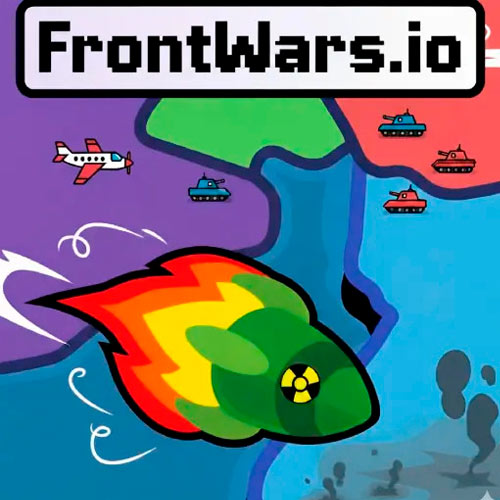
FrontWars.io is an online multiplayer strategy game about building territory, managing your strength, expanding across the map, and competing against other players for control. You start with a relatively small position and have to decide how to grow from there. You can claim new territory, prepare for battles, defend your borders, and look for opportunities to weaken rival players. The basic controls are easy to understand, so you can start playing without much preparation, but the real challenge comes from making smart decisions once the map becomes crowded.
I like strategy games that give me a sense of ownership.
Not necessarily in the traditional sense. I don’t need to build a giant city or manage hundreds of different buildings. Sometimes all I need is a small piece of territory on a map and the feeling that what happens to it is entirely up to me.
That’s what I noticed while playing FrontWars.io.
At the beginning of a match, everything feels manageable. You have your starting position, some room around you, and plenty of possible directions to expand. Nobody seems particularly threatening yet.
Then everyone starts growing.
Suddenly, that comfortable little space isn’t so comfortable anymore.
One player is expanding toward you. Another is becoming stronger on the other side of the map. Someone else has already started a fight with a neighboring player. The quiet opening is gone, and now every decision feels a little more important.
That’s when FrontWars.io becomes interesting.
I think new players often make the same mistake I made when I first started: they assume the goal is simply to get as much territory as possible.
It makes sense.
If you’re playing a territorial strategy game, getting bigger feels like progress.
But FrontWars.io taught me that size can be misleading.
A huge territory can be difficult to defend. A long border can become a weakness. Expanding into the wrong area can put you directly next to a player who is much stronger than you.
So I started thinking about territory differently.
Instead of asking, “How much land can I take?” I began asking, “What does this land actually do for me?”
That’s a much better question.
A new area might give you more room to expand, a useful position, or a better defensive shape. But it can also create another border that you now have to worry about.
For beginners, I’d recommend learning this idea early. Don’t expand simply because you can. Look at the map and consider what your next move means for the move after that.
You don’t have to plan ten moves ahead.
Even planning two moves ahead is a huge improvement.
One of the reasons I enjoy FrontWars.io is that other players constantly interfere with whatever plan you had in mind. You can start a match with a perfect strategy and then discover that someone else has decided to expand directly toward you.
Now what?
You have to adapt.
Maybe you defend.
Maybe you expand in another direction.
Maybe you attack first.
Maybe you decide that the other player isn’t actually a threat and leave them alone.
There isn’t always an obvious answer.
And I think that’s where the multiplayer element makes the game work.
A computer opponent can challenge you, but human players create uncertainty. You don’t know whether the person next to you is going to attack immediately or quietly build their strength for ten minutes.
You have to watch them.
I’ve had matches where I underestimated someone simply because they weren’t expanding very quickly. I assumed they were weak. Then I realized they had been building a strong position while I was busy fighting someone else.
That was an unpleasant surprise.
It was also a useful lesson.
Never assume that a quiet player is an irrelevant player.
 Experienced players understand this naturally. They don’t just look at who has the most territory. They watch how players are behaving. They notice who is fighting, who is expanding, who seems to be avoiding conflict, and who might suddenly become dangerous.
That kind of awareness takes time to develop.
You won’t have it after one match.
And that’s fine.
Your early games should be about learning.
If you lose because you expanded too quickly, remember it.
If you lose because you attacked without enough strength, remember it.
If another player surprises you because you weren’t watching the map, remember that too.
Those mistakes eventually become instincts.
I also like the tension created by choosing when to fight. Battles can be exciting, but I don’t think FrontWars.io is at its best when you simply attack everything around you.
The interesting part is deciding whether the fight is worth it.
Maybe you can win the battle, but it will cost you so much that another player will take advantage afterward.
Maybe your opponent is weaker, but defeating them would put you next to a much stronger rival.
Maybe two other players are already fighting, and the smartest thing you can do is wait.
I’ve learned to appreciate those quiet decisions.
Sometimes you can gain more by watching than by attacking.
Of course, I don’t always follow my own advice.
There are moments when I see a weak opponent and immediately think, “This is my chance.”
Then I attack.
Sometimes it works beautifully.
Sometimes I regret the decision almost immediately.
That’s part of the fun.
The game doesn’t guarantee that your plan will work. You have to accept that every strategy carries some risk.
For experienced players, I think this is where FrontWars.io becomes more rewarding. Once you’ve learned the basics, you can start developing your own style. Maybe you’re a cautious player who prefers strong defensive positions. Maybe you enjoy aggressive expansion. Maybe you like waiting until other players weaken themselves before making your move.
There isn’t necessarily one correct personality for the game.
You can play it your way.
I also think the game’s presentation supports that freedom. The focus stays on the map and the decisions you’re making. You don’t need complicated visuals to understand what is happening. In a strategy game, I would much rather have a clear battlefield than a flashy interface that gets in the way.
The straightforward design makes it easier to concentrate.
And concentration matters.
When several players are expanding at once, missing one important change on the map can completely alter your plans.
For beginners, I’d suggest checking the map regularly. Don’t get so focused on your own territory that you forget everyone else exists. Watch the players around you and think about where their expansion might take them.
For experienced players, start looking for patterns.
Which players are aggressive?
Who seems overly cautious?
Who is expanding too quickly?
Who is becoming powerful without attracting much attention?
Those observations can help you decide where to move next.
As for replayability, I think FrontWars.io has the right foundation. No two matches need to play out exactly the same because the players create different situations. Still, I would like to see more variety over time. Additional maps, new objectives, different modes, or extra strategic mechanics could give veteran players even more reasons to return.
But I wouldn’t want the developers to lose the simplicity that makes the game approachable.
That’s part of its appeal.
You can understand what you’re doing almost immediately.
Mastering it is another story.
And that gap between understanding and mastery is where I think FrontWars.io finds its sweet spot.
I started playing because I liked the idea of expanding across a map.
I kept playing because I wanted to understand why some of my empires collapsed while others survived.
The difference was rarely one massive decision.
Usually, it was a series of small choices.
I expanded a little too far.
I ignored one player.
I attacked too early.
I waited too long.
I failed to notice a weak border.
Those little decisions add up.
Eventually, you start making better ones.
That’s what makes FrontWars.io satisfying for me. Winning is great, obviously, but improving is almost as enjoyable. You remember the mistakes from previous matches and try not to repeat them.
Then, one day, you look at the map and realize you’re surrounded by opponents, your borders are holding, your resources are under control, and your strategy is actually working.
That’s a good feeling.
Because in FrontWars.io, building an empire isn’t really the difficult part.
Keeping it alive is.
And honestly, I think that’s what makes the game worth coming back to.